
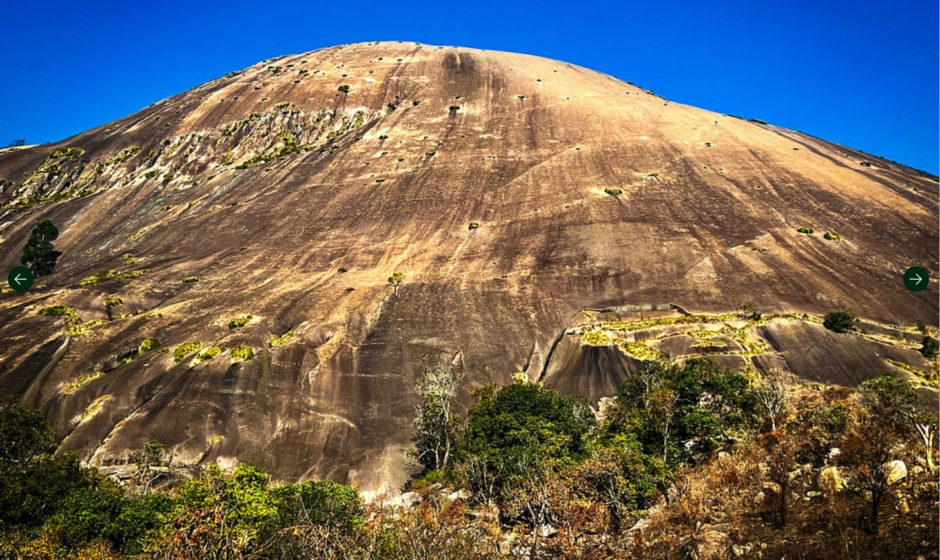

An ancient granite giant, a gruelling school expedition and a story about a mysterious man searching for gold. More than three decades later, Sibebe Rock in Eswatini—one of the kingdom’s greatest natural landmarks—is calling me back.
By Bongani Tshabalala | Eswatini Central
Discover Eswatini | Nature, Heritage & Travel
The Ancient Giant of Pine Valley
Some places remain with us long after we have left them.
Not necessarily because we understood their importance at the time, but because of the experiences, people and stories we associate with them.
For me, Sibebe Rock is one such place.
Just north of Mbabane, Eswatini’s capital, an enormous granite formation rises above the picturesque Pine Valley. Its imposing slopes dominate the surrounding landscape, creating one of Southern Africa’s most extraordinary natural spectacles.
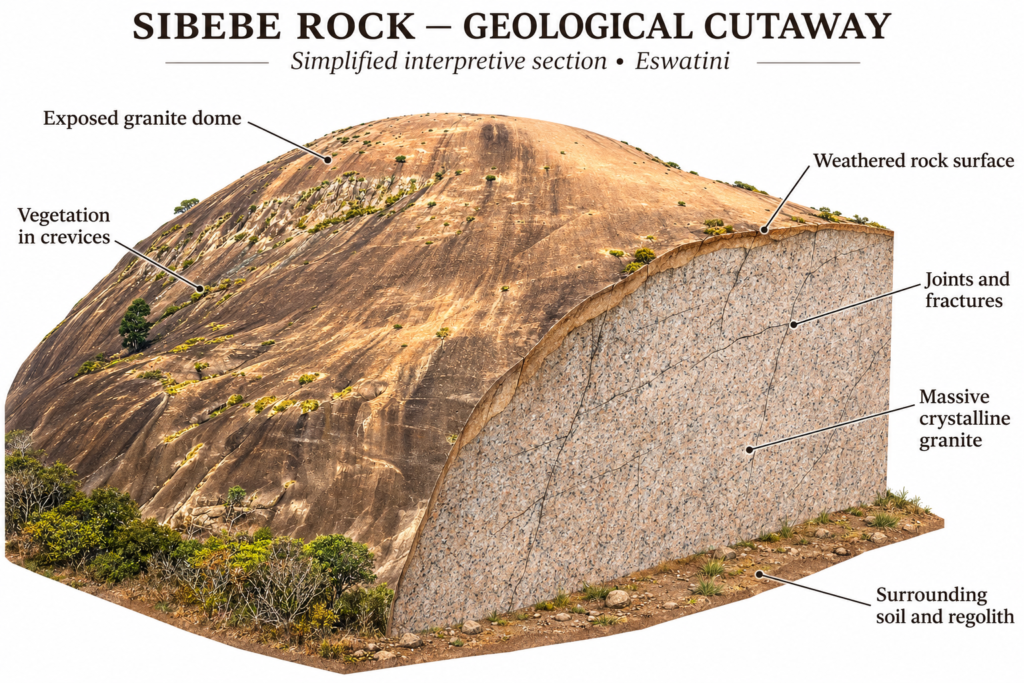
Estimated to be nearly three billion years old, Sibebe is frequently described as the world’s largest exposed granite dome.
To put that age into perspective, Sibebe existed long before the dinosaurs, long before humanity and long before the continents assumed their familiar shapes.
It has endured immense geological transformations while the world around it continued to change.
And yet, when I first encountered this ancient giant, geological history was probably the last thing on my teenage mind.
I was far more concerned with surviving a school hiking expedition.
A Journey Back to 1989 or 1990
My earliest personal memories of Sibebe date back to around 1989 or 1990, when I was a Form Three or Form Four student at St Christopher’s High School in Luyengo.
I was involved in the Prince Makhosini Award Scheme and the Interact Club, which operated under the Malkerns Rotary Club.
One of our activities was an overnight hiking expedition that would take us from Mbuluzi Girls’ High School, through Mbabane and Mhlambanyatsi, eventually finishing at St Christopher’s hostel.
Looking back, I am not entirely certain whether we appreciated the magnitude of what we had undertaken.
We were young, inexperienced and woefully unprepared.
Our footwear was hardly appropriate for serious hiking. Our backpacks contained all manner of unnecessary possessions, and our knowledge of outdoor survival was limited.
One particularly enthusiastic member of our group had packed a duvet, a pillow and cologne.
Yes, cologne!
Perhaps he had anticipated a considerably more luxurious experience than the one awaiting us.
To add to our difficulties, we had been loaned an old military canvas tent.
Anyone familiar with those tents will appreciate that portability and lightweight convenience were not among their defining characteristics.
Nevertheless, armed with youthful enthusiasm and an abundance of misplaced confidence, we set off from Mbuluzi on Saturday morning.
A Night in Mbabane and the Long Road Home
By Saturday evening, we had reached Mbabane, where we spent the night camping at a school somewhere in town.
For a group of teenagers, the prospect of experiencing a little of Mbabane’s nightlife proved rather tempting.
Unfortunately, youthful excitement does not always encourage sensible decisions.
What seemed like an attractive proposition on Saturday evening became considerably less appealing when Sunday morning arrived.
We still had a demanding journey ahead of us.
Our route would take us through Mhlambanyatsi towards St Christopher’s in Luyengo, crossing terrain that was steep and physically exhausting in places.
At some point, we decided to navigate as the crow flies.
We had no compass, no meaningful navigational training and only a vague appreciation of the difficulties that lay ahead.
What we lacked in experience, we compensated for with youthful arrogance and determination.
It was not always a particularly effective combination.
The terrain tested us. Our equipment weighed us down. Our inappropriate footwear gradually took its toll.
But we continued.
By mid-afternoon on Sunday, we finally arrived at St Christopher’s hostel.
We had completed our expedition, although the physical consequences would remain with us for several days.
Throughout the following week, we attended classes nursing blistered feet and aching muscles.
It was an unforgettable lesson in preparation, endurance and the consequences of youthful overconfidence.
Yet somewhere along that journey, another memory took root.
A story about Sibebe Rock.
The Legend of Sibebe: A Man, a Mountain and a Promise of Gold
During our expedition, fellow students recounted a story about how the enormous rock had acquired its name.
According to the version we were told, a man named Sibebe had learned that gold could be found at the summit of the granite formation.
Motivated by the promise of discovering the precious metal, he attempted to climb the imposing rock.
Tragically, the story continued, he fell to his death during the attempt.
We were told that the rock subsequently became known by his name.
Whether this account was based on an actual historical event, a traditional legend or simply a cautionary tale passed between generations remains uncertain.
I have not been able to establish a documented historical source confirming it.
Nevertheless, the story stayed with me.
And therein lies an intriguing aspect of Eswatini’s heritage.
Many of the Kingdom’s landscapes have histories that extend beyond what is recorded in tourist brochures or conventional historical accounts.
Some stories survive through the spoken word, passed from one generation to another.
They may evolve over time, acquiring different interpretations, details and meanings.
The challenge is distinguishing established history from folklore while recognising the cultural value of both.
More than three decades after hearing that story, I remain curious.
Who was Sibebe?
Was there ever a man by that name associated with the rock?
And if the story is folklore, where did it originate?
These are questions I hope to investigate when I return.
Three Billion Years in the Making
Beyond the legends and personal memories lies an extraordinary geological story.
Sibebe forms part of the ancient granite landscape surrounding Mbabane.
Granite originates when molten rock cools and solidifies deep beneath the Earth’s surface. Over immense periods of time, geological forces and erosion gradually expose formations that were once buried underground.
Sibebe’s distinctive rounded surfaces, enormous boulders and expansive exposed granite slopes are products of these natural processes.
The rock is frequently compared with Australia’s celebrated Uluru, although the two landmarks are geologically different.
While Uluru consists predominantly of sandstone, Sibebe is granite.
The surrounding landscape offers an equally compelling attraction.
Visitors exploring Sibebe can encounter sculpted boulders, pockets of indigenous vegetation, caves, seasonal streams and spectacular views across Eswatini’s highlands.
Its grasslands and sheltered habitats support a variety of plants and birds, including species of conservation interest.
During the rainy season, water flowing down portions of the exposed granite creates a particularly striking spectacle.
However, these conditions can also make the rock dangerously slippery.
For those wishing to explore its upper reaches, established hiking routes and knowledgeable local guides offer a more appropriate introduction than the youthful improvisation that characterised my own expedition all those years ago.
A Natural Treasure Worth Exploring
One of the most compelling aspects of Sibebe is that its appeal extends well beyond the rock itself.
Pine Valley, the surrounding rural communities and the broader Mbabane highlands offer opportunities for scenic exploration, nature photography, hiking and cultural discovery.
Community-based tourism initiatives provide opportunities for visitors to explore the landscape with local guides while contributing to the livelihoods of people living in the area.
This is an important dimension of sustainable tourism.
Natural attractions should not exist merely as destinations where visitors arrive, take photographs and depart.
They can also support surrounding communities, encourage environmental conservation and provide opportunities for cultural exchange.
For Eswatini, Sibebe represents precisely this kind of opportunity.
It is an internationally significant geological landmark situated within a landscape rich in local character.
Visitors planning to explore the area can also consult the Kingdom of Eswatini’s Sibebe Rock guide for hiking information and details about the surrounding landscape. it deserves to be experienced as more than a passing attraction.
Returning to Sibebe: A Different Journey
More than three decades have passed since that memorable school expedition.
The teenager who once struggled through the highlands with unsuitable footwear and an overloaded backpack has grown older.
Hopefully, a little wiser too.
This time, I intend to return to Sibebe under very different circumstances.
There will be no military canvas tent, no unnecessary overnight excursions into Mbabane’s nightlife and certainly no attempts to navigate unfamiliar terrain without proper preparation.
Instead, I want to explore Sibebe and its surroundings with the curiosity and appreciation that come with age.
I want to experience Pine Valley properly, discover its scenic viewpoints, learn more about the communities living around the rock and, perhaps most importantly, investigate the traditional stories associated with its name.
I also intend to experience Sibebe Resort, a leisure and accommodation destination overlooking this remarkable landscape.
The resort offers an opportunity to explore a different dimension of the Sibebe experience: combining the area’s natural beauty with accommodation, hospitality, recreation and relaxation.
For Eswatini Central, this forthcoming visit will provide an opportunity to review the destination firsthand.
I want to discover what makes the resort appealing, examine its facilities, experience its hospitality and consider the value it offers visitors seeking an escape into Eswatini’s highlands.
The journey will also provide opportunities to explore other attractions in the surrounding area.
But above all, I want to stand before Sibebe again, this time with a greater appreciation of the extraordinary history represented by its ancient granite slopes.
Some Places Deserve a Second Look
It is remarkable how our relationship with a place can change over time.
As a teenager, Sibebe was a landmark encountered during an exhausting journey between two schools.
My immediate concerns were practical: the weight of my backpack, the discomfort of my shoes and the seemingly endless distance remaining before we reached home.
Today, my interests are different.
I am curious about the rock’s geological origins, the stories passed down by surrounding communities and the experiences available to travellers who venture beyond Eswatini’s familiar tourist routes.
I also find myself increasingly drawn to the idea of rediscovering the landscapes that formed part of my youth.
Sibebe has stood for billions of years, largely indifferent to the brief human dramas unfolding around it.
Generations have come and gone.
Young hikers have struggled across its surrounding hills, and others have admired its imposing beauty from the valleys below.
The rock remains.
And somewhere among its ancient granite slopes, perhaps, lies an answer to the story of a man who went searching for gold.
My next journey to Sibebe will not simply be about revisiting an old memory. It will be about discovering a familiar place with new eyes.
This is the first instalment of Eswatini Central’s exploration of Sibebe Rock and its surroundings. In our forthcoming feature, we return to Pine Valley to explore the area, experience Sibebe Resort and discover what this extraordinary destination offers today’s traveller.
Eswatini Central — Discover the Kingdom. Experience the Story.
Planning a visit to the Mbabane highlands? Read my Hilton Garden Inn Mbabane review for a comfortable city accommodation option.
Travelling from Johannesburg to Eswatini? My TransMagnific shuttle review explores the comfort, convenience and experience of making the journey by road.